About the Journal

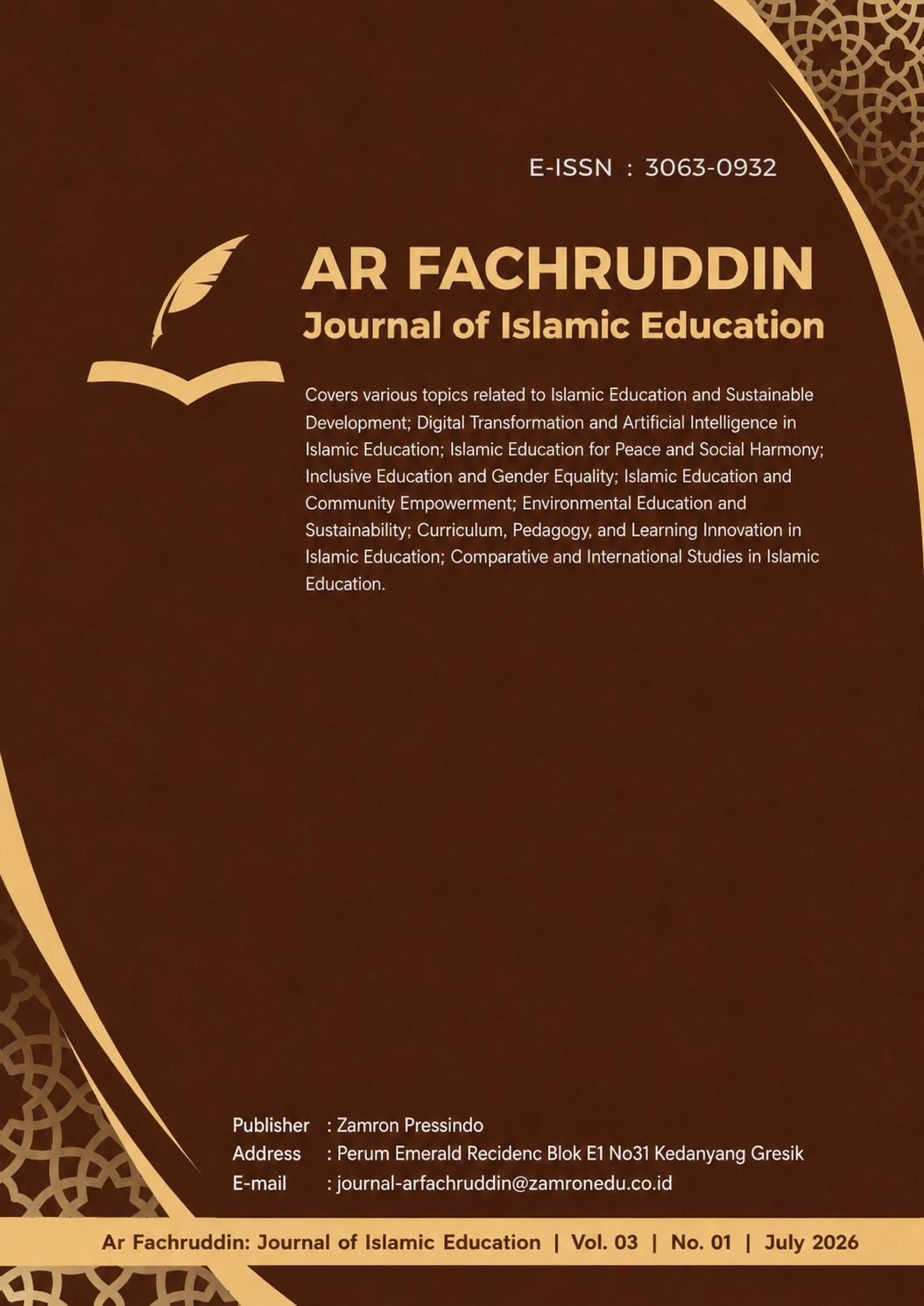
Ar-Fachruddin: Journal of Islamic Education covers a broad range of topics, including Qur’an- and Hadith-Based Islamic Education, Innovation in Islamic Education, Islamic Education and Science, Islamic Education and Social Transformation, Deradicalization in Islamic Education, Gender and Islamic Education, Comparative Studies in Islamic Education, Pesantren Education, Madrasah Education, Islamic Education Curriculum, Philosophy of Islamic Education, Islamic Education Policy, Leadership in Islamic Education, and Prominent Figures in Islamic Education.

The journal is published biannually, in July and December. Ar-Fachruddin: Journal of Islamic Education welcomes contributions from academics and researchers in the form of original research articles, literature reviews, case studies, and theoretical papers that contribute to the advancement of knowledge and practice in the fields of Islamic education and learning innovation within their respective disciplines. Submitted manuscripts must be original, unpublished, and not under consideration for publication elsewhere. All manuscripts must be written in English.

Announcements

Call for Paper Vol. 3 No. 1 (2026)

2026-05-24

Volume 3, Issue 1 (2026) of Ar-Fachruddin: Journal of Islamic Education is a special issue dedicated to Islamic Education (PAI) teachers, both those teaching in Indonesia and abroad. This issue is designed as an academic platform to accommodate ideas, critical reflections, pedagogical innovations, and research findings of PAI teachers in responding to the dynamics of Islamic education across diverse social, cultural, and institutional contexts.

Read more about Call for Paper Vol. 3 No. 1 (2026)
Current Issue

Vol. 2 No. 2 (2025): Transforming Islamic Education through Digital Innovation, Immersive Learning, and Holistic Student Development
					View Vol. 2 No. 2 (2025): Transforming Islamic Education through Digital Innovation, Immersive Learning, and Holistic Student Development

This theme highlights the transformative role of digital innovation, immersive technologies, and student-centered approaches in advancing the quality of Islamic education and students’ holistic competencies. It emphasizes that contemporary Islamic education must move beyond conventional teaching models by integrating AI chatbots, gamified learning, learning analytics, augmented reality, and self-regulated learning strategies to foster motivation, engagement, learning outcomes, spiritual competence, and character development. Furthermore, the theme underscores the importance of aligning technological advancement with Islamic values, religious moderation, ethics, and learner autonomy to ensure that Islamic education remains adaptive, interactive, and relevant in responding to the demands of the digital era.

Published: 2025-12-31
View All Issues

Ar-Fachruddin: Journal of Islamic Education is indexed and abstracted in the following databases: